Best Accounting & Bookkeeping Software for Startups, SMEs, and Enterprises
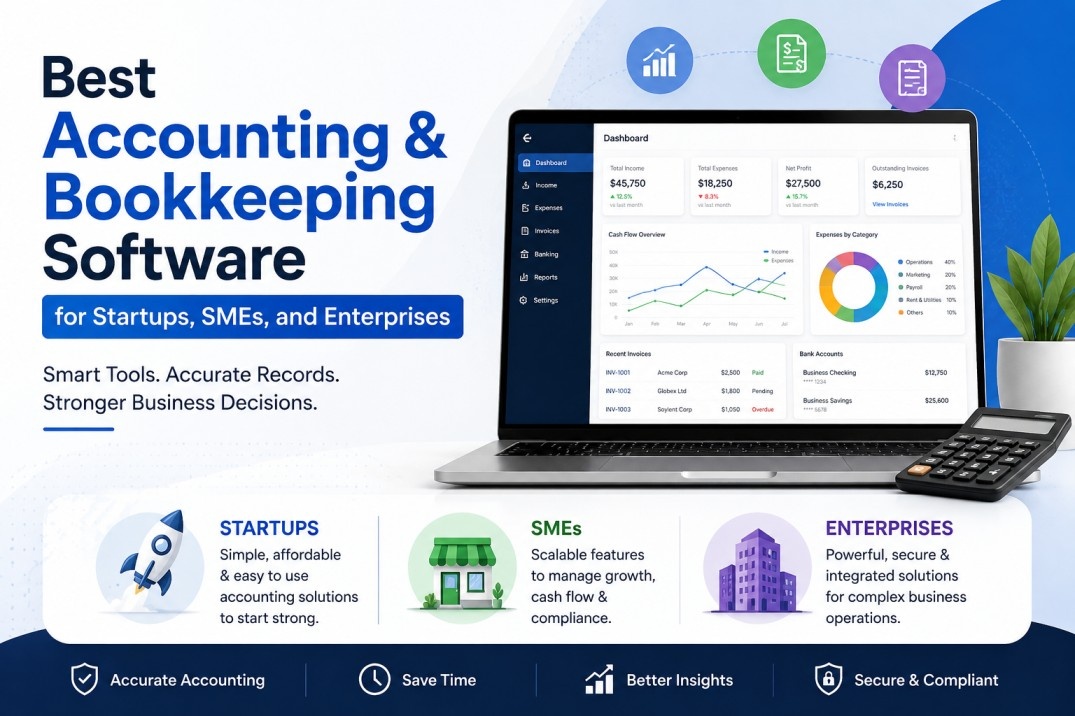
Best Accounting & Bookkeeping Software for Startups, SMEs, and Enterprises
Choosing the right accounting and bookkeeping software is one of the most important financial decisions a business can make, regardless of size or industry. Whether you're a startup founder tracking your first invoices, an SME managing multi-location operations, or a large enterprise handling complex financial reporting, the right online bookkeeping software can save time, reduce errors, and improve cash flow visibility — and GPMJ Global's bookkeeping experts can help you get there faster.
In this guide, we break down the top bookkeeping and accounting software for small business and enterprise use — including QuickBooks, Xero, Zoho Books, NetSuite, Sage, and Odoo — and explain which platforms work best for industrial businesses, restaurants, hotels, and growing companies. Note that while QuickBooks, Xero, and Zoho Books are true bookkeeping tools, NetSuite, Sage, and Odoo are broader accounting, ERP, and business management platforms that include bookkeeping as one part of a larger system.
Why the Right Software Matters
Accurate financial statements, clean bank reconciliation, and organized accounts payable and receivable form the backbone of every healthy business. Poor bookkeeping leads to cash flow problems, tax filing errors, and missed growth opportunities. A reliable cloud accounting software solution automates expense tracking, simplifies invoicing and billing, and gives business owners real-time access to their general ledger and profit and loss statement — from anywhere in the world. If managing all of this in-house feels overwhelming, outsourcing your bookkeeping to the experts is often the faster, more accurate route.
Comparison Table: QuickBooks vs Xero vs Zoho Books vs NetSuite vs Sage vs Odoo
|
Software |
Best For |
Key Strength |
Complexity |
Price Position |
|
QuickBooks |
Small/medium businesses |
Ease of use |
Low |
$$ |
|
Xero |
SMEs / international SMEs |
Multi-currency & integrations |
Low–Medium |
$$ |
|
Zoho Books |
Startups / small businesses |
Affordability |
Low |
$ |
|
NetSuite |
Mid-market / enterprise |
ERP & multi-entity |
High |
$$$$ |
|
Sage |
Manufacturing / construction |
Inventory & costing |
Medium–High |
$$$ |
|
Odoo |
Integrated operations |
ERP + CRM + inventory |
Medium–High |
$$$ |
Top Software Compared in Detail
QuickBooks remains one of the most popular choices for small and mid-sized businesses in the US and Canada. It offers strong payroll integration, automated bank feed integration, and an intuitive dashboard, making it a common entry point for bookkeeping software for beginners.
Xero is widely favored across the UK and Australia for its clean interface, multi-currency support, and strong third-party app ecosystem. It's a popular QuickBooks alternative for businesses that need flexible, cloud-first accounting, particularly those operating internationally.
Zoho Books is a cost-effective option for startups and freelancers, offering solid automated bookkeeping features, receipt scanning, and integration with the wider Zoho suite — making it a strong pick for bookkeeping software for self-employed professionals and small teams.
NetSuite, an Oracle product, is primarily suited to mid-sized and large businesses, including companies preparing for significant multi-entity or global growth. Its robust financial reporting tools and ERP-level capabilities go well beyond basic bookkeeping.
Sage offers industry-specific accounting solutions, particularly strong in manufacturing, construction, and industrial business accounting, with deep functionality around inventory and cost tracking.
Odoo stands out as an all-in-one business management platform, combining accounting with inventory, CRM, and operations — a good fit for companies wanting an integrated system beyond standalone small business accounting software.
Which Software Should You Choose?
-
Startup → Zoho Books or QuickBooks
-
SME → QuickBooks or Xero
-
International SME → Xero or QuickBooks
-
Manufacturing / Industrial → Sage, NetSuite, or Odoo
-
Multi-entity enterprise → NetSuite
-
Business wanting ERP + CRM + inventory in one system → Odoo
Not sure which one fits your business? Get expert bookkeeping guidance from GPMJ Global before you commit to a platform.
Best Software for Industrial Businesses
Industrial and manufacturing companies deal with complex inventory, cost of goods sold, and multi-department budgeting. NetSuite and Sage are commonly used here, offering advanced chart of accounts customization and detailed cash flow management tools. Odoo is also worth considering for manufacturers wanting bookkeeping tied directly to production and supply chain data. Our bookkeeping support for industrial businesses can help you set up and manage whichever platform fits your operations.
Best Software for Restaurants
Restaurants need software that handles high transaction volumes, tips, inventory waste, and daily reconciliations. QuickBooks and Xero are frequently used thanks to their available POS integrations and ease of use, while Zoho Books can work well for smaller, single-location restaurants needing an affordable solution. As with any software choice, confirm POS compatibility with your specific provider before committing. Our restaurant bookkeeping specialists can help you stay on top of daily reconciliations without the headache.
Best Software for Hotels
Hotels and hospitality businesses require software that can manage multiple revenue streams, seasonal cash flow, and multi-currency transactions for international guests. NetSuite and Sage offer the reporting depth larger hotel groups often need, while Xero is commonly used by boutique hotels and smaller hospitality operators across the UK and Australia. Our hotel accounting professionals can help you stay reconciled across every property, every season.
Best Software for Growing Companies
For SMEs and enterprises scaling across regions, a combination of flexibility and reporting power matters most. Zoho Books and QuickBooks typically suit early-stage growth, while NetSuite, Sage, and Odoo support companies transitioning into more complex, multi-entity operations. Wherever you are on that journey, GPMJ Global's growth-ready bookkeeping team can scale support alongside you.
Final Recommendation
If you're a startup or small business prioritizing ease of use and cost, start with QuickBooks or Zoho Books. If you're an international SME, Xero is worth strong consideration. If you're scaling into multi-entity or manufacturing operations, NetSuite, Sage, or Odoo will likely serve you better long-term.
At GPMJ Global, we help businesses across the US, UK, Canada, and Australia select, implement, and manage the right accounting system for their industry and stage of growth through our outsourced bookkeeping services. Still weighing your options? Talk to our bookkeeping specialists today and let's find the right fit for your business.
Frequently Asked Questions
What is the best bookkeeping software for a small business?
QuickBooks and Zoho Books are generally the most accessible options for small businesses, offering low complexity and affordable pricing.
Is Xero better than QuickBooks?
Neither is universally "better" — Xero tends to suit international SMEs needing multi-currency support, while QuickBooks is often preferred by US and Canadian small businesses for its simplicity and payroll integration.
Is NetSuite suitable for startups?
NetSuite is generally better suited to mid-market and enterprise businesses rather than early-stage startups, due to its cost and complexity. Startups are usually better served by QuickBooks or Zoho Books until they scale.
What accounting software is best for manufacturing?
Sage, NetSuite, and Odoo are commonly used in manufacturing due to their inventory management, cost tracking, and production-linked accounting features.
What is the best multi-entity accounting software?
NetSuite is widely used by businesses managing multiple entities or subsidiaries, thanks to its consolidated reporting and ERP-level capabilities.